
Your First Turntable Setup: What You Need Before Buying Records
Build a first vinyl system with a clear signal path, realistic accessory budget, and room for everyday listening.
Our advice is based on published information and practical buying considerations, not hands-on testing. Product links in this article are direct manufacturer links. If a link earns us a commission, we label it. Read our affiliate disclosure.

You bring home a favorite album, set it on a new turntable, and discover that the speakers cannot connect the way you expected. First-time vinyl purchases often go wrong between the components rather than at the record itself. A little planning makes the difference between an enjoyable evening ritual and a collection of incompatible boxes.
Write the signal chain before choosing a turntable: cartridge, phono stage, amplification, and speakers. Some products combine several stages. Others need separate components. Your job is to make sure every stage exists once in the correct place, using the instructions for the exact equipment you buy.
Choose a system style
| Setup | Why choose it | What to check |
|---|---|---|
| Turntable with built-in phono stage and powered speakers | Fewer separate boxes | Correct line-output setting |
| Turntable plus separate phono stage and powered speakers | More component choice | Additional cables and outlet |
| Turntable and amplifier with suitable phono input | Uses an existing stereo system | Cartridge and input compatibility |
| All-in-one record player | Minimal setup | Speaker placement and future flexibility |
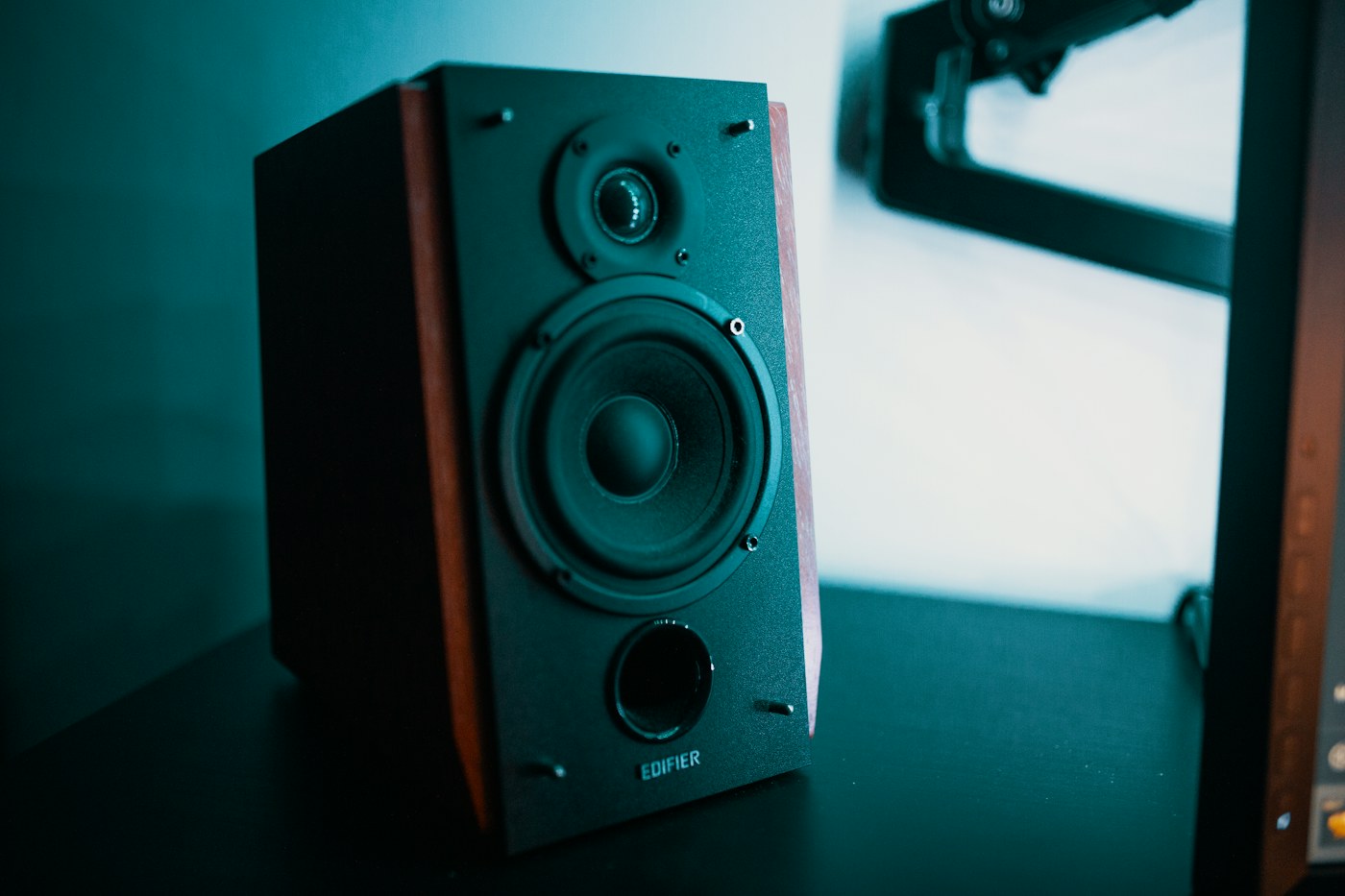
Edifier R1280T powered speakers are one product to investigate for the speaker end of a compact wired system. Their official documentation describes the model and its connections. They are not a substitute for a phono stage: verify that the upstream turntable or separate component supplies the appropriate line-level signal.
Understand the phono-stage question
The signal coming from a conventional turntable cartridge needs the appropriate phono amplification and equalization before reaching a normal line input. If the turntable has a switchable built-in phono stage, the switch position matters. Follow the manual rather than trying combinations at high volume.
A connection labeled AUX or line input should not automatically be treated as a phono input. Conversely, sending an already processed line signal into an unsuitable phono input is not the intended path. If a listing leaves this unclear, obtain the manual before buying. This one check can prevent an unnecessary return and an extra accessory order.
Give the record player a stable home
Choose a level, stable surface with enough room to open the lid and handle a record safely. Keep the player away from places where people knock the furniture or pull at trailing cables. Consider separating speakers from the turntable's surface to reduce the opportunity for vibration to feed back into playback.
Measure the full operating space, not just the closed footprint shown in a listing. A shelf may fit the player but leave no room to lift the lid or move the tonearm comfortably. If the only location is inconvenient, reconsider the arrangement before purchasing a more expensive deck.
Automatic convenience or manual ritual?
Think honestly about how you will listen. An automatic mechanism may appeal if you want fewer steps at the beginning or end of a side. A manual turntable asks for more participation. Neither choice creates an automatic guarantee of sound quality; these are workflow differences that should fit your habits.
Check how the cartridge or stylus is replaced, what setup is required, and which accessories are included. Some designs arrive with fewer adjustments to make, while others require more careful setup. Avoid paying for adjustability you do not want to learn, but do not assume every beginner product has the same upgrade path.
Budget beyond the deck
Allow for appropriate cables, a record brush, safe record storage, and eventual stylus replacement. You do not need a shelf of cleaning gadgets immediately. Begin with the care instructions for your records and equipment, then add accessories only when they solve a clear problem.
Skip vinyl as a convenience purchase if you primarily want uninterrupted background music from your phone. Its appeal includes choosing a record, handling it, and changing sides. Streaming can remain the practical choice for busy workdays while records become an occasional listening ritual.
Before checkout
- Draw every connection from cartridge to speakers.
- Confirm where phono processing and amplification occur.
- Measure lid clearance and speaker placement.
- Check replacement stylus availability for the exact model.
- Include required cables and basic care supplies in the budget.
Frequently asked questions
Do powered speakers remove the need for a phono stage?
Not necessarily. Powered refers to speaker amplification. You still need appropriate phono processing unless the relevant component already provides it.
Should I buy a complete bundle?
A clearly documented compatible bundle can simplify shopping. Compare the exact model numbers and included accessories, because a bundle title alone does not prove the signal chain is complete.
Explore the options
Use the manufacturer’s current specifications to confirm the exact version, compatibility and return terms before buying. Prices and availability can change.
Edifier R1280T powered speakers
Why consider it: A speaker-side option for a wired system with appropriate upstream phono processing.
The tradeoff: A separate or built-in phono stage is still required.
Explore at the manufacturer ↗Sources & further reading
Source information checked September 30, 2026. Product revisions and regional availability may differ.
See something that needs correcting? Contact our editorial inbox.
Keep exploring
View all
The Commuter’s Guide to Headphones You Will Actually Carry
Choose commuting headphones around comfort, bag space, awareness, and your daily route—not just noise cancellation.

Buying Earbuds for Office Calls: Start With Your Workday
A practical guide to call comfort, microphone expectations, connection switching, and choosing earbuds for hybrid work.
Desktop Speakers for a Small Workspace: Buy the Setup, Not Just the Boxes
How to choose a compact desktop speaker system around desk space, connections, volume controls, and shared rooms.